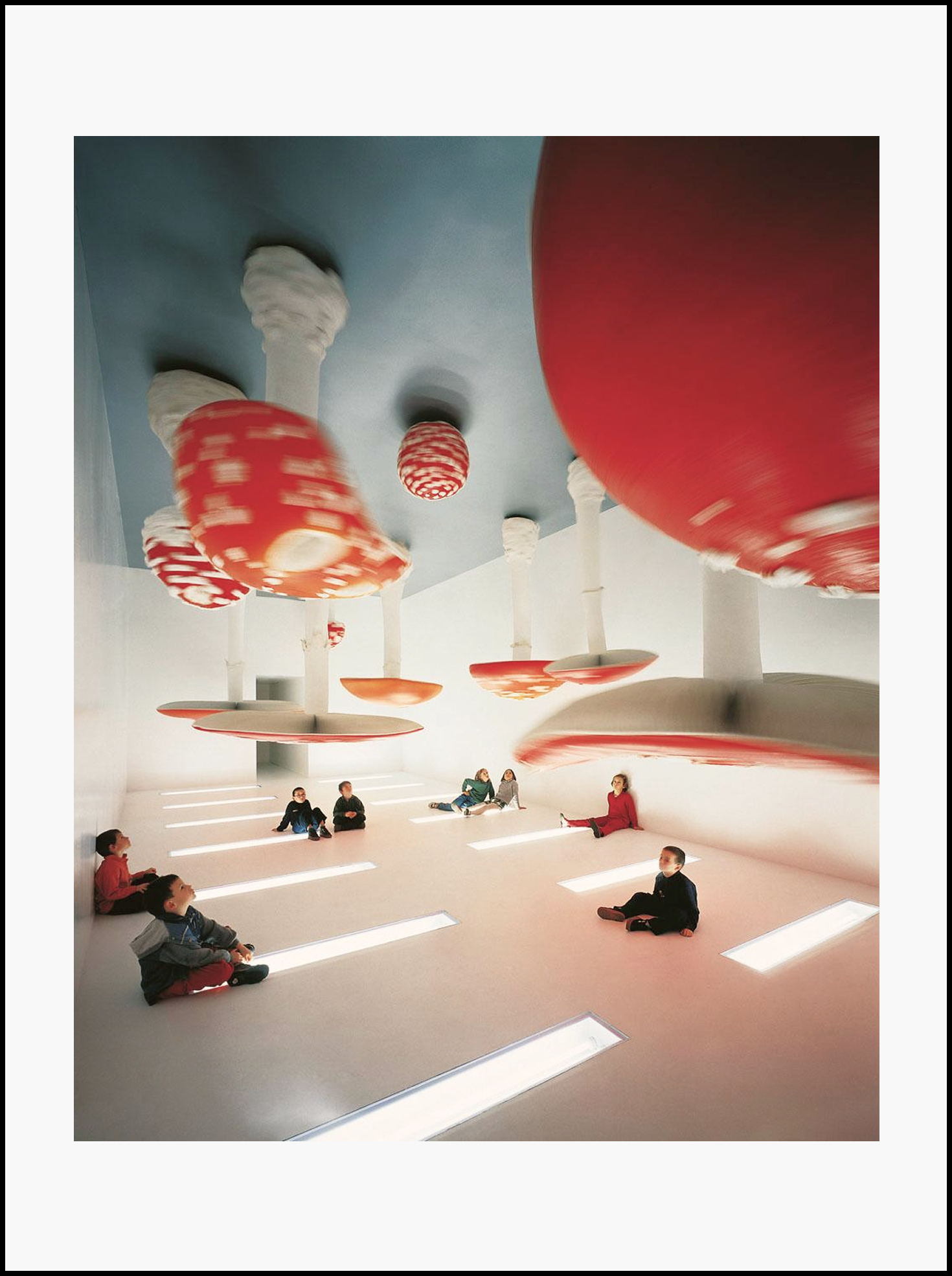
Carsten Höller — Upside Down Mushroom Room (2000)
Artist Overview
Artist: Carsten Höller (b. 1961, Brussels)
Background: Belgian-German artist with a PhD in biology
Practice: Installation art, experiential environments, perceptual experiments
Carsten Höller is known for transforming scientific concepts into playful, disorienting installations.
With a background in biology and a fascination with psychology, he frequently uses mushrooms—especially Amanita muscaria—as symbols of altered perception, duality, and sensory confusion.
Works Overview
Since the late 1990s, Höller has created multiple installations featuring oversized mushroom sculptures.
Across these works, mushrooms serve as both biological specimens and metaphors, bridging nature and consciousness.
His most iconic installation is the immersive:
Upside Down Mushroom Room (2000)
• A room filled with large red-and-white fly agaric mushrooms
• All sculptures are inverted and suspended from the ceiling
• Each mushroom slowly rotates, creating a hypnotic environment
Upside Down Mushroom Room (2000)
Commission / Exhibition: Fondazione Prada, Milan
The installation presents giant Amanita muscaria sculptures hanging upside down from the ceiling.
By reversing the mushrooms’ orientation and adding rotational movement, Höller destabilizes viewers’ expectations of gravity and space.
The gallery becomes a surreal, dream-like forest—an environment where “up” and “down” lose their meaning.
The work evokes mushroom-associated ideas of psychedelia and altered states, encouraging viewers to question how perception constructs reality.
Through inversion and repetition, Höller turns fungi into instruments of sensory experimentation.
Concept & Significance
Höller’s mushroom installations explore:
• Perception & disorientation — how simple shifts in orientation alter sensory experience
• The biological imagination — using fungi as forms that blur the boundaries between science and fiction
• Altered consciousness — referencing cultural associations between mushrooms, hallucination, and dream logic
• Playful critique — destabilizing categories of natural/artificial, logic/illogic
His mushrooms are not replicas but perceptual tools—objects that challenge viewers to inhabit a space between experiment and imagination.
Date:
January 9, 2026
Category: