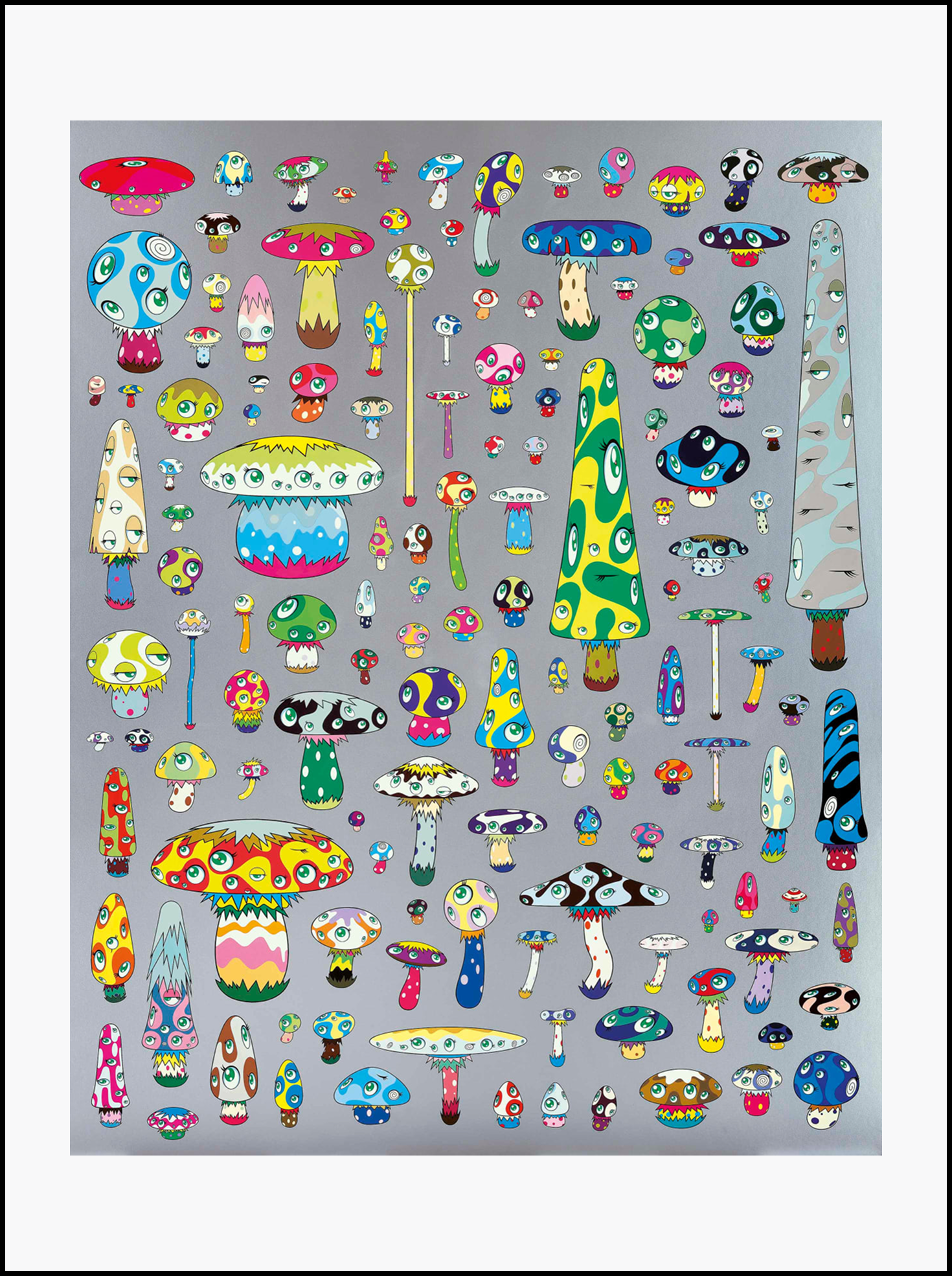
Takashi Murakami — Mushroom Paintings (1990s–2000s)
Artist Overview
Artist: Takashi Murakami (Japan)
Movement: Superflat, Contemporary Art
Practice: Painting, sculpture, animation, pop art, cultural critique
Takashi Murakami is one of Japan’s most influential contemporary artists, known for merging high art, commercial aesthetics, and otaku culture.
While works like the Flower series gained mainstream recognition, mushrooms appear throughout his paintings and sculptures as recurring symbolic motifs.
Works Overview
Series: Mushroom Paintings (1990s–2000s)
Murakami’s mushroom imagery shifts between playful cartoon aesthetics and darker psychological undertones.
Across this body of work, mushrooms serve as both decorative pop icons and charged cultural symbols.
His mushrooms range from:
• Cute, smiling cartoon forms
• Surreal, erotic, or grotesque iterations
• Warped shapes referencing psychological distortion
• Multi-eyed or mutated mushrooms hinting at mutation and trauma
Project Description
Murakami frequently uses mushrooms as a visual metaphor to explore themes of transformation, innocence, and contamination.
In Japanese visual culture, mushrooms are tied to nature, but in the postwar era, they also evoke the atomic mushroom cloud — a symbol of national trauma and cultural rupture.
By combining childlike cuteness with unsettling undertones, Murakami blurs the boundary between pleasure and fear, fantasy and historical memory.
Concept & Significance
Murakami’s mushroom works address:
• Consumer culture: Mushrooms as mass-producible icons within the Superflat aesthetic
• Postwar trauma: Echoes of the mushroom cloud and radiation-related mutation
• Psychedelic references: Link to 1960s counterculture and altered consciousness
• Duality: Cute vs. disturbing, commercial vs. critical, natural vs. artificial
Through this layered symbolism, mushrooms become a lens for examining Japanese identity, pop culture, and collective memory.
Date:
January 9, 2026
Category: